Showing posts with label dxing. Show all posts

Tuesday, October 14, 2014

Dxing 101!

http://www.qsl.net/crosscarc/pdf/DXing101.PDF

Dxing 101!


DX

…What is it?


Just two letters; but these two little letters have excited hundreds of thousands of hams worldwide, launched expeditions to countless exotic locations and been the catalyst for many countries around the world to tear down political barriers and allow their citizens to join the amateur radio community. DX stands for DISTANCE, but DX is a relative term: DX stations might be 2000 miles away on the HF bands, 200 miles on the VHF/UHF bands, or 20 miles at microwave frequencies. Most DXers gained their experience on the HF bands from 160 meters to 10 meters. And, although those bands are what this brochure will concentrate on, all DXers share a common characteristic: the thrill of the chase, and capturing a QSO with someone who is far, far away. For us, it’s exciting to snag a new country or new island, or even a new grid square, by digging a callsign and signal report out from behind a wall of noise and interference. There’s just something special about snagging a contact with a guy in New Guinea, Japan, Pakistan or Sweden using your own rig and antennas that is hard to beat!

…What do YOU need to work it?

You do not need a big station to work DX. A surprising amount of DX has been worked from modest stations with meager antennas. A basic transceiver and some good dipoles will get you going in DXing. Some NADXC members have gotten to the 300 country level using 5 watts! Build your station as your interest and finances dictate. Adding a little more power or putting up a beam will improve your score, but if that’s not in the cards, you can still work a lot of stuff with a minimal station. Concentrate on improving your listening ability and your operating technique; it will pay handsome dividends, especially if you don’t have the loudest signal on the band.

…Where Do You Find It?

On the HF (High-Frequency) bands, you’ll find DX signals on all modes including SSB, CW, digital (RITTY, Pactor, Amtor, Packet), SSTV(Slow Scan TV) and ATV(Amateur TV), and even FM(but rarely).

For the past several years, during the recent lull in the seven-year sunspot cycle, DX could be heard on the "high-bands" (20-10 meters) only during daylight hours, and on the "low-bands" (160,
80/75, and 40 meters) only during nighttime hours. This is because energy radiated from the Sun during sunspot activity affects radio propagation (the way our atmosphere reflects and refracts radio signals), and sunspots have been on the decline until just recently. So, as the Sun becomes more active over the next three or four years, it will be easier than ever to find exotic DX on all our HF bands. The new solar cycle (cycle 23) has already begun to get DXers around the world excited with the prospects of "easy pickin’s" nearly any hour of the day on many of the HF bands. For now (Summer ’98), try 20 or 17 meters during morning, evening and late night times. Fifteen and Ten meters are usually best for Europe near daybreak and for the Pacific at dusk, and are sometimes open to Africa & Asia mid-day, while the low-bands (160-40) will be open, but noisy, at night. As Fall approaches and the Sun angle changes, the low bands will become quieter and you’ll be able to
hear DX there, too. At the peak of the cycle, a couple years off, the high-bands, especially 10 meters, will allow round-the-world contacts with really low power and modest antennas. If you haven’t heard 10 meters filled wall-to-wall with strong DX stations, you have a real treat in store! Contrary to what many people think, working DX is not difficult, and the more you work, the more you will sharpen your skills. You will learn about equipment, antennas, QSLing, propagation, pileup technique, operating etiquette, and before you know it, you, too, will be a DXer!

Look for DX here:

Band Characteristics Where’s the DX?
160 Late evening/night; best in winter 1820-1850 kHz.
80/75 Late evening/night, early morning; best in winter CW: 3500-3530; SSB: see SPLIT
40 Early evening through early morning; Fall through Spring CW: 7000-7030; SSB: see SPLIT
30 Sometimes like 40, sometimes like 20. Try it! CW and digital only; mixed anywhere
20 Open somewhere 24 hours, best Fall through Spring CW: 14.000-14.040; SSB: 14.150-14.250
17 Sometimes like 20, sometimes like 15. Days/Eve. CW: 18.068-18.100; SSB: 18.110-18.168
15 Daybreak to Noon: Europe/Africa, CW: 21.000-21.150; SSB: 21.150-21.350 Midday to
Evening: Asia /Pacific
12 Sometimes like 15, Sometimes like 10. Try it! CW: 24.090-24.930; SSB: 24.930-24.990
10 Lots of surprises! Dawn & Dusk best but improving! CW: 28.000-28.100; SSB: 28.300 & up

Start tuning around your favorite band on the frequencies your license class permits – no use getting frustrated listening to all that good stuff down in the Extra Class band if you can’t work there. But it certainly does provide an incentive to upgrade!

The most fun is to prove these predictions wrong! Band openings to a specific part of the world can sometimes really be surprising and interesting. A good DXer is a good Short Wave Listener FIRST. Listen, Listen, Listen! Tune, Tune, Tune!

…How Do You Work It?

Casual DXing is usually done like any other QSO. For example: a short response to a CQ, using your full callsign on the DX station’s frequency should result in a nice conversation. Many DX operators speak English fairly well, and can at least exchange name, location, signal report, and often will enjoy a nice ragchew. CW operators can use Q-signals even if they don’t share a common language. If you’re on SSB, give a few short calls on his frequency using International phonetics that your DX target is likely to understand: "Kilo Foxtrot Four Zanzibar Tango Sierra" is
a lot more easily understood than "Kilo Fox Four Zany Tennis Shoes". Speak slowly and clearly -- none of the cutesy stuff.

Split operation: On some bands and modes, U.S. stations cannot transmit where the DX station can, so you’ll often hear the DX station announce a ‘listening frequency’. For example, F2XXX in France, CQ’ing on 7035 might say "listening 7130". That’s your cue to set up your rig for split operation with each of two VFO’s on a separate frequency. You listen on his transmit frequency and he listens on your transmit frequency. It’s a little like repeater splits, but with freedom to pick your own (legal) frequencies. This can get a little tricky until you become comfortable with the way your particular rig works in split mode. After a while it’ll be second nature, but at first, listen to how other ops are handling it.

Rare DX: Sometimes a place with few or no active hams will be visited by a "DX-pedition" with operators, equipment and antennas ready to put a "new country" on the air for the benefit of DXers around the world. Or, perhaps it’s just a case of a less rare area with especially good propagation. Whatever the reason, you’ll know something’s up, because there will be a whole group of stations calling the DX all at the same time. This is affectionately known as a pile-up. The size of the pile will be an indication of the rarity of the DX! Pileups require a little technique…here’s where you can gain a real advantage by using a little knowledge and planning:

Plan to go split: The DX will usually try to move the pile away from his transmit frequency in order to be heard over the masses, so be ready to transmit where he’s listening. It makes no sense to call him on his own frequency once he says "listening UP TEN", or "200 to 220", or just "UP"!

Get in step: The DX op will try to catch one complete callsign from the pile on the first call, and will try to establish a rhythm that benefits everyone with a lot of contacts during the time propagation is in our favor. So send just your full call once, with STANDARD phonetics, on his listening frequency, then listen for his response.

Play the pileup: If you can figure out what his tuning pattern is, you can often anticipate where he’ll be listening next in the pile, and slip your call right in. This works, but takes some patience. If it’s a small pile, you can try picking a spot just on the edge…move around a little. Try to be noticed. Does it sound like Bass fishing? Yup.

Time your calls: Sometimes a little delay (a second or two) will let your call stand out among the rest as they taper off. Really experienced operators seem to have a knack for sensing the most opportune time to throw out their call. This is a pretty subtle skill that will pay off if practiced.

Follow his lead: If the DX op wants the pile to move, spread out, squeeze up, go by numbers, speed up, slow down…whatever…do it (legally). On CW, try to respond at his speed.

Don’t react to others: Don’t be tempted to be a traffic cop by telling others they are on the "wrong vfo" or "up, lid!" All this does is add to the problem. If you hear an obvious jammer, work around him; he wants to get a rise out of us, and he is thwarted when we IGNORE him. Patience! Discipline!
Don’t be discouraged: Busting pileups on the first or second call is for the "BIG GUNS". The rest of us "little pistols" have to replace brute power with skill and cunning. You Can Do It. Too! Be patient. Listen. Figure out how the guy is playing the pile. Listen, Listen, Listen and LEARN.


…Now What?

You’ve done it…you worked the DX…so? Most DX chasers like to have a QSL card to confirm the deed, and if you want to apply for any of the many DX awards offered by the world ham community, you’ll need that confirmation. The most prestigious and sought after award is ARRL’s DX Century Club (DXCC), awarded for confirming contact with 100 different "entities" (call them countries, for now). There are over three-hundred ‘countries’ identified for DXCC purposes, and most are inhabited by active hams, so the first hundred is attainable with even the most modest station…especially in the next few years. If you become hooked on collecting countries, you’ll join
a huge group of like-minded DXers around the world who think this is the most exciting and challenging aspect of ham radio, and who will welcome you as a member of their fraternity. You don’t need to be a big-gun; you don’t even need a hundred countries…just the desire and interest will identify you as a DXer!


…How Do You Get Help?

Elmers- You may already know what an Elmer is – a nickname for someone who is really helpful at showing you the ropes. North Alabama DX Club abounds with them, and we love to help out beginning DXers with advice, tips, technical help, and moral support. We love to watch ‘em grow!

WWW- There are lots of DX-oriented sites on the Internet. We have our own that is open to everyone (www.nadxc.org). Other prominent sites include those sponsored by the Texas DX Society, Potomac Valley Radio Club, Northern California DX Club, several European and Asian sites. All are easy to use, have helpful tips and info, and have lots of links to data, software, propagation forecasts and news.

Magazines- DX Publications abound. They run the gamut from weekly advisory DX bulletins, monthly columns in QST, slick magazine DX publications like THE DX Bulletin. NADXC also publishes a monthly summary of current DX happenings in our own monthly LONGPATH.

Clusters- Packet Clusters are an excellent help to the new or seasoned DXer. Packet Clusters are networks that link up cities into large spotting networks. Hook in to our own local one on 144.93 or
145.73 and watch your screen for awhile. You will get the hang of it in a hurry. DX alerts (Spots) will appear from DXers all over the Southeast telling you what the callsign and frequency is of something they just spotted. There are also lots of other aids there, like current propagation info, an online callbook, help with hard-to-identify prefixes, QSL advice, and a QSL manager’s directory. Talk to W4NS for more info.

NADXC-The North Alabama DX Club is one of the oldest DX organizations in the South. They meet once a month at a Huntsville area restaurant, sponsor two 2-meter repeaters (147.30/90, and
147.10/70) for providing DX info, a terrific Webpage (www.nadxc.org) on the internet, as well as the Packet Cluster. Dues are nominal, and they are a super helpful group. They’ll help get you started on the right track, offer you a helping hand, and even tell you what traps to avoid right from the start.

Publications- Check out the stuff in ARRL’s Operating Manual, the ARRL handbook, the ARRL Antenna Handbook, or any of the others in the list of good ARRL publications. There’s help there on any subject you can think of. Don’t forget to get yourself a copy of the ARRL DXCC Countries List and see what countries, islands and other entities count for your country totals.

Friday, February 8, 2013

New International Reply Coupon Introduced

http://www.arrl.org/news/view/new-international-reply-coupon-introduced
New International Reply Coupon Introduced
02/06/2013

The Universal Postal Union (UPU) has introduced the newest model of the International Reply Coupon (IRC): The Doha model -- so named for the 25th Universal Postal Congress that took place in Doha, Qatar in October 2012 -- will replace the current model, known as the Nairobi model. Although the US Postal Service (USPS) no longer sells IRCs, they are still available in other countries and post offices in the US are mandated to redeem them.

The Doha model IRC will go on sale on July 1, 2013. It is valid for exchange it until the end of 2017. The Nairobi model -- first issued on July 1, 2009 -- remains valid until December 31, 2013. IRCs are exchangeable in every UPU member country for stamps representing the minimum postage for an ordinary priority letter-post item or airmail letter sent abroad for a reply. According to the UPU, 120 postal systems around the world worldwide had issued more than four million Nairobi IRCs with a total value of approximately $5 million as of October 31, 2012.

Although postal systems are not obliged to sell IRCs, it is mandatory for them to exchange the coupons. According to the UPU, if a postal system -- such as the USPS -- does not sell IRCs, it is possible to purchase them in a post office located in another country.

The Czech Republic won the UPU’s contest to design the new IRC, beating out 13 other countries. Czech artist and graphic designer Michal Sindelar designed the new IRC, whose design illustrates the theme “Water for Life.” This theme reflects the United Nations International Year of Water Cooperation in 2013. --Thanks to The Daily DX for some information


About international reply coupons


New design in 2013

The Czech Republic has won the UPU's competition to design a new international reply coupon (IRC), beating 13 or countries. The work of Czech artist and graphic designer Michal Sindelar will display the theme "Water for Life", chosen to reflect the 2013 UN International Year of Water Cooperation.

The new "Water for Life" IRC will go on sale on 1 July 2013. Postal customers will be able to exchange it until the end of 2017. It will replace the current coupon, known as the Nairobi model, which was first issued on 1 July 2009 and will remain valid until 31 December 2013.
How does it work?

When one writes to a stranger and requests a reply, it is considered polite to enclose a self-addressed stamped envelope. This works well when both persons live in the same country; however, if they are from different countries, the enclosed postage stamp will not be valid.

This technical problem was solved in 1906 when the Universal Postal Union, during its Congress in Rome, introduced the International Reply Coupon service. As the service began before the days of airmail, the earliest coupons could only be redeemed for a single-rate ordinary postage stamp to a foreign country. In terms of today's UPU Convention, International reply coupons (IRC) are exchangeable in all member countries for the minimum postage of a priority item or an unregistered airmail letter sent to a foreign country.
Mandatory to exchange

The UPU's International Bureau processes several million coupons each year and deals with of all accounting aspects. The International Bureau does not sell IRCs directly to customers; they must buy them from their local post office. Although Posts are not obliged to sell IRCs, it is mandatory for Posts to exchange the coupons. If a Post does not sell IRCs, it is possible to purchase them in a post office located in a neighbouring country.

Thursday, February 7, 2013

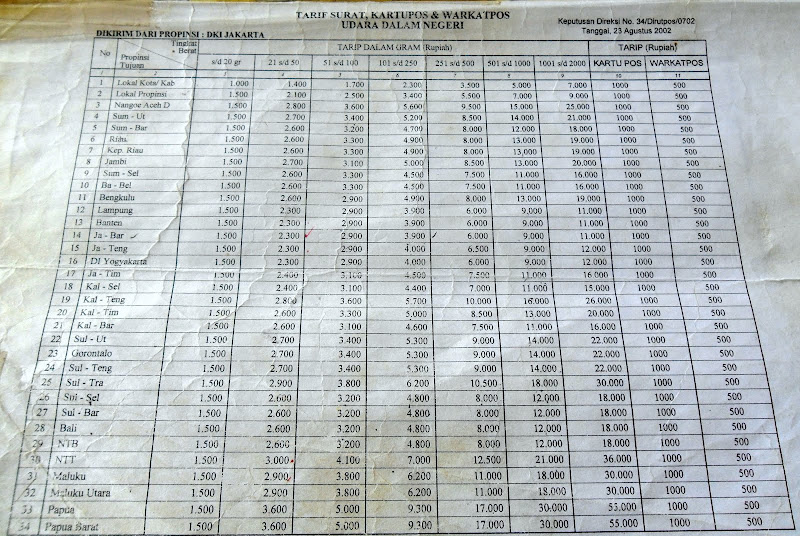
DAFTAR TARIF POS

http://nanien.wordpress.com/2011/10/29/daftar-tarif-perangko/


Mau kirim kartu pos ke negara Mauritius, berapa ya perangkonya?

Surat gw berat banget banget karena isinya puluhan lembar. Butuh berapa perangko ya biar nyampe Maroko?

Dari pengalaman mengirim kartu pos dari berbagai tempat, tidak semua petugas familier dengan tarif pos. Untuk beberapa saat, gw luntang-lantung. Awalnya gw hanya mengandalkan perkataan abang-abang Warpostel FISIP UI.

Asia 3 rebu.
Eropa 4 rebu.
Amerika 5 rebu.

Tapi menurut kantor pos Pinang Ranti, semua perangko ke luar negeri 10rb. Kemana pun. Berapapun beratnya. Loh kok?

Jiwa jurnalis gw tergerak (prikitiww) untuk cek dan ricek. Harus pastikan fakta ke sumbernya langsung. Solusinya, gw langsung meminta daftar tarif dari kantor pos pusat. Problem solved!!

Silakan cek berapa perangko yang dibutuhkan untuk kirim kartu pos/surat ke daerah Indonesia, Asia Pasifik, Afrika, Amerika, dan Eropa di link masing-masing.

Banyak yang bilang kalo petugas ngasih tarif beda-beda. Maka dari itu, kalo gw sih menganut paham: tempel perangko sendiri dari rumah (dengan tarif yang benar), jadi saat ke kantor pos kita langsung naro surat/kartu pos. Biasanya kalo kita langsung ngasih petugasnya gak banyak omong. Kalopun ngomong ini perangkonya kurang, bilang aja kalau ini tarif dari pusat. Dan selama ini kartu pos dan surat yang gw kirim nyampe aja kok. Jadi, gw selalu nyimpen stok perangko yang banyak (bisa beli di Kantor Filateli). Pas lagi keabisan perangko ya terpaksa harus beli on the spot sih. Kadang petugas langsung interogasi kita mau ngirim kemana, gw sih langsung minta aja mau perangko berapa, gak bilang negara apa. Begitu deh, tips agar gak kecolongan ngirim pake perangko terlalu mahal ya sepertinya memang harus tempel perangko sendiri. Kalo ada waktu, sempetin deh main ke Kantor Filateli. Ragam perangko yang bisa dibeli di Kantor Filateli tentu jauh lebih banyak daripada kantor pos. Berarti kan kita bisa ngirim perangko yang lebih lucu-lucu juga~

Okeee? Jadi saat ditanya mau kirim kemana? Lebih baik langsung bilang, saya beli perangko 3500 tiga buah. Kalo petugas protes, bilang aja ini saya ngikutin daftar kantor pos pusat. Mudah-mudahan dapet petugas yang baik dan gak rese ya. Soalnya temen gw pernah dimarah-marahin petugas kantor pos Tangerang karena membantah anggapan bahwa kirim kartu pos ke luar negeri itu dipukul rata perangkonya seharga sepuluh ribu rupiah. Yah, lagi apes, ganti kantor pos deh

ps: Tarif ini diberlakukan mulai tahun 2002. Gw hanya mengetik ulang daftar yang ada di kantor pos pusat. Kalau ada kesalahan nama negara, kemungkinan besar itu eror dari Kantor Posnya

beberapa catatan:
Apa sih warkat pos? Menurut bung Hendro di komen ini:

Warkat Pos : selembar kertas kurang lebih ukuran A4 atau lebih kecil, biasanya berwarna biru muda yg DULU dijual di kantor pos. Gunanya : utk mengirim surat/berita yg kita tulis di lembaran warkat pos itu. Setelah itu warkatpos kita lipat sesuai garis yg sdh ada menjadi bentuk spt amplop, dilem pinggirannya sedikit. Bagian muka utk ditulis nama/alamat tujuan & tempel perrangko dan bagian belakang nama/alamat pengirim. Jadi isi surat tertulis pada lembar bagian dalam/sebaliknya.

Sepakat? Gue juga belom pernah liat jadi jangan tanya sama sayah.
Perangko buat surat yang bagian mana?

Kalo suratnya cuma berisi beberapa kertas enteng, ya berarti kategori 20 gram. Kalo nulis suratnya sama kaya nulis skripsi, ya berarti lebih dari 20 gram. Kalo gak yakin, timbang aja suratnya. 

Gw suka menimbang surat pake timbangan buat bikin kue kalo nyelipin sesuatu yang agak berat kaya suvenir gantungan kunci yang bisa dimasukin ke amplop.

Kalo lebih gak yakin lagi, serahkan perhitungan perangko pada petugas pos di kantor pos besar. Kalo di kantor pos cabang yang gedenya cuma warung kadang suka bingung kalo gw ngasih surat ke luar negeri. Antrilah di loket, beri suratnya, bilang mau kirim kemana, apakah paket kilat atau biasa. Nanti petugas akan menimbang dan menentukan harga kirim (bisa perangko atau kilat. Kalo kilat gak pake perangko).

Last but not least, gw bukan petugas pos. Jadi kalo emang mau nanya lebih lanjut coba sempatkan ke kantor pos besar (kalo perlu pusat) dan tanya langsung sama yang berwenang ya


DALAM NEGERI

Berikut ini adalah tarif perangko untuk mengirim kartu pos dan surat ke berbagai daerah di Indonesia. Tarif ini khusus untuk benda pos yang dikirim dari DKI Jakarta.


beberapa catatan:
Apa sih warkat pos? Menurut bung Hendro di komen ini:

Warkat Pos : selembar kertas kurang lebih ukuran A4 atau lebih kecil, biasanya berwarna biru muda yg DULU dijual di kantor pos. Gunanya : utk mengirim surat/berita yg kita tulis di lembaran warkat pos itu. Setelah itu warkatpos kita lipat sesuai garis yg sdh ada menjadi bentuk spt amplop, dilem pinggirannya sedikit. Bagian muka utk ditulis nama/alamat tujuan & tempel perrangko dan bagian belakang nama/alamat pengirim. Jadi isi surat tertulis pada lembar bagian dalam/sebaliknya.

Sepakat? Gue juga belom pernah liat jadi jangan tanya sama sayah.
Perangko buat surat yang bagian mana?

Kalo suratnya cuma berisi beberapa kertas enteng, ya berarti kategori 20 gram. Kalo nulis suratnya sama kaya nulis skripsi, ya berarti lebih dari 20 gram. Kalo gak yakin, timbang aja suratnya.

Gw suka menimbang surat pake timbangan buat bikin kue kalo nyelipin sesuatu yang agak berat kaya suvenir gantungan kunci yang bisa dimasukin ke amplop.

Kalo lebih gak yakin lagi, serahkan perhitungan perangko pada petugas pos di kantor pos besar. Kalo di kantor pos cabang yang gedenya cuma warung kadang suka bingung kalo gw ngasih surat ke luar negeri. Antrilah di loket, beri suratnya, bilang mau kirim kemana, apakah paket kilat atau biasa. Nanti petugas akan menimbang dan menentukan harga kirim (bisa perangko atau kilat. Kalo kilat gak pake perangko).


TARIF PERANGKO UNTUK ASIA PASIFIK

TARIF KARTU POS, WARKAT POS, DAN SURAT UDARA LUAR NEGERI ASIA PASIFIK

No KelompokNegara Kartu pos Warkat pos

Tingkat berat (Gram)/ Rp
s/d 20 gr >20 gr s/d 50 gr >50 gr s/d100 gr >100 gr s/d250 gr >250 gr s/d500 gr >500gr s/d1000 gr >1000 gr s/d2000 gr
A

ASIA PASIFIK

Kelompok I
1 Brunei 2.500 3.000 4.000 8.000 14.000 35.000 55.000 100.000 140.000
2 Laos
3 Malaysia
4 Singapura
5 Thailand

Kelompok II
1 Australia 3.000 3.500 4.500 10.000 18.000 40.000 65.000 120.000 180.000
2 Bangladesh
3 Bhutan
4 India
5 Jepang
6 Korea Selatan
7 Maladewa
8 Nepal
9 Pakistan
10 Philipina
11 Srilanka
12 Vietnam

Kelompok III
1 Afganistan 2.500 3.500 4.500 10.000 15.000 40.000 60.000 125.000 180.000
2 Nagru
3 Papua Nugini
4 RRC (Cina)
5 Selandia Baru

Kelompok IV
1 Hongkong 2.500 3.500 4.000 10.000 15.000 35.000 55.000 110.000 150.000
2 Macau
3 Kamboja
4 Korea Utara
5 Myanmar
6 Taiwan

Kelompok V
1 Bahrain 3.000 4.000 5.500 11.000 20.000 50.000 70.000 130.000 190.000
2 Irak
3 Iran
4 Israel
5 Kuwait
6 Mongolia
7 Qatar
8 Saudi Arabia
9 Uni Arab Emirat

Kelompok VI
1 Lebanon 3.000 3.500 5.500 11.000 20.000 50.000 70.000 130.000 190.000
2 Oman
3 Turki
4 Yaman
5 Yordania

Kelompok VII
1 Adniralitet 3.000 3.500 5.500 13.000 24.000 55.000 85.000 150.000 240.000
2 Ceton, Kep
3 Cook, Kep
4 Ellica, Kep
5 Fiji, Kep
6 Flinder, Kep
7 Gilbert, Kep
8 Guam
9 Hanover
10 Howe Lord
11 King, Kep
12 Midway, Kep
13 New Britain
14 New Celedonia
15 New Hebriden
16 New Irlandia
17 Norfolk, Kep
18 Samoa
19 Salamon, Kep
20 Tabiti
21 Tongga
22 Tuyulu
23 Yamualata
24 Wake


AFRIKA

TARIF KARTU POS, WARKAT POS, DAN SURAT UDARA LUAR NEGERI AFRIKA

No KelompokNegara Kartu pos Warkat pos

Tingkat berat (Gram)/ Rp
s/d 20 gr >20 gr s/d 50 gr >50 gr s/d100 gr >100 gr s/d250 gr >250 gr s/d500 gr >500gr s/d1000 gr >1000 gr s/d2000 gr
A

AFRIKA
Kelompok I
1 Algeria 3.000 4.000 5.500 12.000 23.000 55.000 75.000 140.000 140.000
2 Djibaoti
3 Ethiopia
4 Libya
5 Mesir
6 Sudan
7 Tunisia
Kelompok II
1 Afrika Tengah 3.000 4.000 5.000 10.000 18.000 40.000 65.000 120.000 180.000
2 Angola
3 Benin
4 Burundi
5 Cape Verde
6 Chard
7 Gabon
8 Gambia
9 Ghana
10 Guinea
11 Bissau
12 Kamerun
13 Kenya
14 Kongo
15 Liberia
16 Madagaskar
17 Mali
18 Maroko
19 Mauntania
20 Mauritius
21 Namibia
22 Niger
23 Nigeria
24 Pantai Gading
25 Ruwanda
26 Senegal
27 Seychelles, Kep
28 Siera Leone
29 Somolia
30 Tanzania
31 Togo
32 Uganda
33 Volta Hulu
34 Burkina
35 Faso
36 Zaire
37 Zambia
Kelompok III
1 Afrika Selatan 3.000 4.000 5.500 12.000 25.000 50.000 90.000 150.000 250.000
2 Botswara
3 Leshoto
4 Mozzambique
5 Swaziland


AMERIKA

TARIF KARTU POS, WARKAT POS, DAN SURAT UDARA LUAR NEGERI AMERIKA

No KelompokNegara Kartu pos Warkat pos

Tingkat berat (Gram)/ Rp
s/d 20 gr >20 gr s/d 50 gr >50 gr s/d100 gr >100 gr s/d250 gr >250 gr s/d500 gr >500gr s/d1000 gr >1000 gr s/d2000 gr
A

AMERIKA
Kelompok I
1 USA 3.500 6.000 8.000 18.000 33.000 70.000 120.000 210.000 330.000
2 Bahama
3 Mexico
Kelompok II
1 Antigua 3.500 5.000 8.000 15.000 37.000 85.000 130.000 240.000 370.000
2 Barbados
3 Barbuda
4 Belize
5 Bermuda
6 Costa Rica
7 Cuba
8 Dominica
9 El Salvador
10 Equador
11 Grenada
12 Guatesala
13 Guyana
14 Haiti
15 Honduras
16 Jamaika
17 Kanada
18 Kolombia
Kelompok III
1 Argentina 3.500 5.000 8.000 15.000 37.000 85.000 130.000 240.000 370.000
2 Bolivia
3 Brazil
4 Chili
5 Paraguay
6 Peru
7 Uruguai


EROPA


TARIF KARTU POS, WARKAT POS, DAN SURAT UDARA LUAR NEGERI EROPA

No KelompokNegara Kartu pos Warkat pos

Tingkat berat (Gram)/ Rp
s/d 20 gr >20 gr s/d 50 gr >50 gr s/d100 gr >100 gr s/d250 gr >250 gr s/d500 gr >500gr s/d1000 gr >1000 gr s/d2000 gr
A

EROPA
1 Albania 4.500 5.000 7.500 15.000 25.000 60.000 90.000 170.000 250.000
2 Armenia
3 Austria
4 Azerbaijan
5 Belanda
6 Belarus
7 Belgia
8 Bosnia
9 Herzegovina
10 Bulgaria
11 Ceko
12 Cyprus
13 Denmark
14 Estonia
15 Finlandia
16 Hungaria
17 Inggris
18 Irlandia
19 Italia
20 Jerman
21 Kazakhstan
22 Kroasia
23 Kyrgistan
24 Latvia
25 Lithuania
26 Malta
27 Moldovia
28 Monaco
29 Norwegia
30 Perancis
31 Polandia
32 Portugal
33 Rumania
34 Rusia
35 Slovakia
36 Slovania
37 Spanyol
38 Swedia
39 Swiss
40 Tajikistan
41 Turkmenistan
42 Ukraina
43 Uzbekistan
44 Vatikan
45 Yugoslavia
46 Yunani

beberapa catatan:

Apa sih warkat pos? Menurut bung Hendro di salah satu komen di blog ini:
Warkat Pos : selembar kertas kurang lebih ukuran A4 atau lebih kecil, biasanya berwarna biru muda yg DULU dijual di kantor pos. Gunanya : utk mengirim surat/berita yg kita tulis di lembaran warkat pos itu. Setelah itu warkatpos kita lipat sesuai garis yg sdh ada menjadi bentuk spt amplop, dilem pinggirannya sedikit. Bagian muka utk ditulis nama/alamat tujuan & tempel perrangko dan bagian belakang nama/alamat pengirim. Jadi isi surat tertulis pada lembar bagian dalam/sebaliknya.

Sepakat? Gue juga belom pernah liat jadi jangan tanya sama sayah.

Perangko buat surat yang bagian mana?
Kalo suratnya cuma berisi beberapa kertas enteng, ya berarti kategori 20 gram. Kalo nulis suratnya sama kaya nulis skripsi, ya berarti lebih dari 20 gram. Kalo gak yakin, timbang aja suratnya.

Gw suka menimbang surat pake timbangan buat bikin kue kalo nyelipin sesuatu yang agak berat kaya suvenir gantungan kunci yang bisa dimasukin ke amplop.

Kalo lebih gak yakin lagi, serahkan perhitungan perangko pada petugas pos di kantor pos besar. Kalo di kantor pos cabang yang gedenya cuma warung kadang suka bingung kalo gw ngasih surat ke luar negeri. Antrilah di loket, beri suratnya, bilang mau kirim kemana, apakah paket kilat atau biasa. Nanti petugas akan menimbang dan menentukan harga kirim (bisa perangko atau kilat. Kalo kilat gak pake perangko).

Wednesday, February 6, 2013

Foreign Postage Rates

http://www.k4hb.com/postage.html

Foreign Postage Rates

If you are sending US dollars for return postage, It should be noted that banks may charge a fee for exchanging foreign currency.
Some countries, such as Canada, charge tax for postage. Some countries, such as Australia, have a cheaper card rate.
(1.65 AUD) All rates listed in these charts are the airmail letter rates. Contrary to what some may say, there's still countries
that can return a card for 1USD or less. When sending stamps for return postage, keep in mind that they are only valid in their
country of origin. Example: US stamps are useless in Canada. French stamps are useless in Spain, even though the Euro is
their common currency. Envelope size is also important. Not only for larger cards, but some countries, such as Hungary, must
pay extra for non-standard envelops. (114mm X 162mm)

The number of cards that can be sent for the rates listed in the charts below will vary from country to country. Most of these
rates will cover up to 20 grams, but some are as low as 10g and as high as 50g. Typically, 10g will cover an envelope and two
average single cards. 20g will cover an envelope and 5 average single cards. It's better to play it safe with borderline situations.

For comments or questions about this site send me an email. Email: K4HB Postage

Bill Plum DX Supplies has been very helpful in alerting me about postal information I have missed. If you are interested in buying
foreign stamps and other supplies, drop Bill a line. Email: Plum DX Supplies

Updated: 03-Jan-2013 ***At the first of the year updates for postage increases are constantly coming in***
USA Rates
Airmail up to 1 oz - 1 USD ($) = 100 Cents (¢)
Effective Date Domestic Canada and Mexico All Other Countries
22 January 2012 0.45 0.85 1.05
27 January 2013 0.46 1.10 1.10
Effective Jan 27, 2013, International forever stamps will be available.

Links


Postal Rates for Airmail Letters
(Exchange rates change daily - See converter at bottom of page)

COUNTRY TARIFFS - RATES USD CONVERSION OFFICIAL POSTAL SITE

Aland Island 1.10 € (US) 1 USD = .75 Euro Posten Åland Ab
1.00 € (Europe) 2 USD = 1.50 Euro International Forever Stamps Available

Albania 60 Lek (US) 1 USD = 104 Lek
? (Europe)

Algeria 33 Dinar (US) 1 USD = 74 Dinar Algérie Poste
32 Dinar (Europe) Plus Surtax

Andorra (Spain) .90 € (US) 1 USD = .75 Euro
.75 € (Europe) 2 USD = 1.50 Euro

Andorra (France) .95 € (US) .80 € (Euro Union + Switzerland)
.95 € (Europe Not EU) 1 USD = .75 Euro

Argentina 13.00 Peso (US) 2 USD = 9.83 Peso Correo Argentino
14.00 Peso (Europe) 3 USD = 14.75 Peso

Armenia 770 Dram (US) 1 USD = 389 Dram
? (Europe) 2 USD = 778 Dram

Aruba 2.15 Florin (US) 1 USD = 1.77 Florin
? (Europe) 2 USD = 3.54 Florin

Ascension Island .40 £ (US) (10g) .50 £ (US) (20g) Royal Mail
.40 £ (Europe) 1 USD = .63 £

Australia 2.35 AUD (US) 1 USD = .96 AUD Australia Post
(Letter) 2.35 AUD (Europe) 2 USD = 1.92 AUD
Australia 1.65 AUD (US) 3 USD = 2.89 AUD
(Card Rate) 1.65 AUD (Europe)

Austria 1.70 € (US) 1 USD = .75 Euro Österreichische Post
.70 € (Europe) 2 USD = 1.50 Euro International Forever Stamps Available

Bangladesh 46 Taka (US) 1 USD = 81.7 Taka Bangladesh Post
37 Taka Europe 10 gram - 38 US - 31 Europe

Barbados 1.80 Dollar (US) (10g) (2.75 Dollar East Europe) Barbados Postal Service
2.20 Dollar (Eu) (10g) 1 USD = 1.96 Dollar

Belarus 6650 Ruble (US) 1 USD = 8230 Ruble Belpochta
6650 Ruble (Europe) International Forever Stamps Available

Belgium 1.34 € (US) 1 USD = .75 Euro BPost
1.13 € (Europe) 2 USD = 1.50 Euro International Forever Stamps Available

Bermuda .70 Dollar (US) (10g) 20 gram - 1.10 (US) - 1.25 (Europe) Bermuda Post Office
.85 Dollar (EU) (10g) 1 USD = 1 Dollar

Bhutan 55 Ngultrum (US) 1 USD = 49.3 Ngultrum Bhutan Post
55 Ngultrum (Europe)

Bolivia 5 Boliviano (US) 1 USD = 6.85 Boliviano
6 Boliviano (Europe)

Brazil 2.30 Real (US) 1 USD = 2.05 Real (BRL) Correios
2.75 Real (Europe) 2 USD = 4.10 Real (BRL)
Brazil 1.20 Real (US)
(Economy Rate) 1.30 Real (Europe)

Brunei 1.60 Dollar (US) 1 USD = 1.23 Brunei Dollar


Bulgaria 2.10 Lev (US) 1 USD = 1.48 Lev Bulgarian Posts
1.50 Lev (Europe) 2 USD = 2.96 Lev
Bulgaria 1.40 Lev (US)
(Economy Rate) 1.00 Lev (Europe)

Canada 1.10 CAD (US) 1 USD = .98 CAD Canada Post
1.85 CAD (Europe)

Chile 470 Peso (US) 1 USD = 483 Peso Correos Chile
470 Peso (Europe)

China 6 CNY (US) 1 USD = 6.27 CNY
? (Europe)

Colombia 6,100 Peso (US) 1 USD = 1,762 Peso Postal de Columbia
6,600 Peso (Europe) 4 USD = 7,048

Costa Rica 385 Colon (US) 545 Colon (AF, AS, OC) Correos de Costa Rica
435 Colon (Europe) 1 USD = 491 Colon

Croatia 12.10 Kuna (US) 1 USD = 5.75 Kuna Hrvatska Posta
10.00 Kuna (Europe) 2 USD = 11.50 Kuna

Cuba .75 Peso (US) 1 USD = 1.00 Peso
.75 Peso (Europe)

Cyprus .68 € (US) 1 USD = .76 Euro Cyprus Postal Services
.51 € (Europe)

Czech Republic 21.00 Koruna (US) 1 USD = 18.98 Koruna Česká Pošta
20.00 Koruna (Europe) International Forever Stamps Available

Denmark 14.50 Krone (US) 1 USD = 5.68 Krone Danmark Post
12.50 Krone (Europe) 2 USD = 11.36 Krone
Denmark 13 Krone (US) 3 USD = 17.04 Krone
(Economy Rate) 11 Krone (Europe)

Ecuador 2.00 USD (US) US Dollar is the currency of Correos del Ecuador
? (EU) Ecuador since 13/03/2000

Egypt 2.50 Pound (US) 1 USD = 6 Pound
? (EU)

El Salvador .75 USD (US) US Dollar is the currency of Correos de El Salvador
1.05 USD (Europe) El Salvador since 01/01/2001

Estonia 1.10 € (US) 1 USD = .76 Euro Eesti Post
1.00 € (Europe) 2 USD = 1.52 Euro

Faroe Islands 14.00 Krona (US) 1 USD = 5.65 Krona Posta Faroe
12.50 Krona (Europe) 2 USD = 11.30 Krone
Faroe Islands 10.50 Krona (US)
(Economy Rate) 8.50 Krona (Europe)

Fiji 1.80 Dollar (US) (20g) 10gram - .90 (US) - 1.20 (Europe) Post Fiji
2.40 Dollar (EU) (20g) 1 USD = 1.75 Dollar

Finland .80 € (US) 1 USD = .75 Euro Itella Posti Oy
.80 € (Europe)
Finland .75 € (US)
(Economy Rate) .75 € (Europe) International Forever Stamps Available

France .95 € (US) .80 € European Union + Switzerland La Poste
.95 (Europe Not EU) 1 USD = .75 Euro
.58 € France & Territories Note: Croatia May Join EU July 2013 International Forever Stamps Available

French Guiana .90 € (US) 1 USD = .75 Euro La Poste
1.13 € (Europe) International Forever Stamps Available

French Polynesia 140 Franc (US) 1 USD = 92.25 CFP Franc (XPF) French Polynesia Poste
140 Franc (Europe) 2 USD = 185 CFP Franc (XPF)

Germany .75 € (US) 1 USD = .75 Euro Deutsche Post
.75 € (Europe)

Gibraltar .51 £ (US) (10g) .73 £ (US) (20g) Gibraltar Post Office
.44 £ (Europe) 1 USD = .63 Pound International Forever Stamps Available

Great Britain .87 £ (US) (10g) 1.28 £ (World Wide) (20g) Royal Mail Group
.87 £ (Europe) 1 USD = .61 Pound

Greece .75 € (US) 1 USD = .76 Euro Hellenic Post
.75 € (Europe) International Forever Stamps Available

Greenland 10.5 Krona (US) 1 USD = 5.65 Krona Tele Post
9.5 Krona (Europe) 2 USD = 11.30 Krone
Greenland 9.5 Krona (US)
(B Rate) 8.5 Krona (Europe)

Grenada 1 ECD (US) 1 USD = 2.68 East Caribbean Dollar Grenada Postal Corporation
1 ECD (Europe)

Guadeloupe .90 € (US) 1 USD = .75 Euro La Poste
1.13 € (Europe) International Forever Stamps Available

Guatemala 6.50 Quetzal (US) 1 USD = 7.6 Quetzal El Correo
8.00 Quetzal (Europe)

Guernsey .59 £ (US) 1 USD = .61 Pound Guernsey Post
.59 £ (Europe)

Honduras 30 Lempira (US) 1 USD = 18.67 Lempira Honducor
35 Lempira (Europe)

Hong Kong 3.00 Dollar (US) 1 USD = 7.75 HK Dollar Hongkong Post
3.00 Dollar (Europe)

Hungary 300 Forint (US) 1 USD = 220 Forint Magyar Posta
260 Forint (Europe)

Iceland 230 Krona (US) 1 USD = 127 Krona Pósturinn
175 Krona (Europe) 2 USD = 254 Krona
Iceland 205 Krona (US)
(B Post) 160 Krona (Europe) International Forever Stamps Available

India 25 Rupee (US) 1 USD = 49 Rupee India Post
25 Rupee (Europe)

Iran 151,000 Rial (US & OC) 1 USD = 12,115 Rial Iran Post Company
87,000 - 103,000 Rial (EU) 8 USD = 96,920 Rial
Iran 90,600 Rial (US & OC) 10 USD = 121,150 Rial Country Groups 1-5
(Surface Mail) 52,220 - 61,800 Rial (EU) 13 USD = 157,495 Rial EU Divided into 3 Country Groups

Ireland .82 € (US) 1 USD = .76 Euro AN Post
.82 € (Europe)

Isle of Man .80 £ (US) (10g) 20 gram - 1.10£ (US) Isle of Man Post Office
.71 £ (Europe) (20g) 1 USD = .63 Pound

Israel 5.90 Schekel (US) 1 USD =3.72 Shekel (ILS) Israel Post
4.00 Schekel (Europe)

Italy 2.00 € (US) 2.50 € (Oceania) Poste Italiane
.85 € Europe) 3 USD = 2.25 Euro

Jamaica 120 Dollar (US) 180 Dollar (Other Continents) Jamaica Post
140 Dollar (Europe) 1USD = 84.98 Dollar

Japan 110 ¥ (US) 1 USD = 79.51 Yen Japan Post
110 ¥ (Europe)

Jersey .80 £ (US) (20g) .70 £ (US) (10g) Jersey Post
.60 £ (Europe) 1 USD = .61 Pound

Jordan 1.00 Dinar (US) 1 USD = .70 Dinar Jordan Post
.80 Dinar (Europe)

Kazakhstan 250 Tenge (US) 1 USD = 148 Tenge Kazpost
? (Europe)

Kenya 95 Shilling (US) 1 USD = 81.85 Shilling Posta Kenya
75 Shilling (Europe)

Korea (South) 750 Won (US) 1 USD = 1125 Won Korea Post
750 Won (Europe) 10 gram - 580 (US) - 580 (Europe)

Kuwait .15 Dinar (US) 1 USD = .27Dinar
.15 Dinar (Europe)

Latvia .60 Lat (US) 1 USD = .52 Lat Latvijas Pasts
.60 Lat (Europe)
Latvia .55 Lat (US)
(B Post) .55 Lat (Europe)

Lebanon 2,250 Pound (US) 1 USD = 1,487 Pound Libanpost
2,250 Pound (Europe

Liechtenstein 1.90 Franc (US) 1 USD = .91 Franc Liechtensteinische Post
1.40 Franc (Europe) 2 USD = 1.82 Franc
Liechtenstein 1.60 Franc (US)
(Economy Rate) 1.30 Franc (Europe)

Lithuania 2.90 Litas (US) 1 USD = 2.60 Litas Lietuvos Pastas
2.90 Litas (Europe)
Lithuania 2.45 Litas (US)
(Economy Rate) 2.45 Litas (Europe)

Luxembourg 1.10 € (US) 1 USD = .76 Euro P & T Luxembourg
.85 € (Europe)

Macau 5.00 Pataca (US) 1 USD = 7.83 Pataca
5.00 Pataca (Europe)

Macedonia 45 Denar (US) 1 USD = 46.8 Denar Makedonska Posta
42 Denar (Europe) (Add Basic Rate to Air Transport)

Madagascar 5000 Ariary (US) 5500 Ariary (Oceania) Paositra Malagasy
3500 Ariary (Europe) 1 USD = 2159 Ariary

Malaysia 1.80 Ringgit (US) 1.40 Ringgit (Oceania) Pos Malaysia
1.50 Ringgit (Europe) 1 USD = 3.04 Ringgit

Maldives 18 Rufiyaa (US) 1 USD = 15 Rufiyaa Maldives Post
16 Rufiyaa (Europe)

Malta .51 € (US) .63 € (Zone C) .86 € (Zone D) Malta Post
.37 € (Europe) 1 USD = .75 Euro

Martinique .87 € (US) 1 USD = .76 Euro La Poste
1.07 € (Europe)

Mauritus 29 Rupee (US) 1 USD = 28.10 Rupee Mauritius Post
? (Europe) (Incomplete)

Mexico 11.50 Peso (US) 15 Peso (Oceania) Correos de México
13.50 Peso (Europe) 1USD = 12.73 Peso

Moldova 6.20 Leu (US) 3.60 Leu (Zone A) Posta Moldovei
4.50 Leu (Europe) 1 USD = 11.58 Leu

Monaco .95 € (US) .80 € European Union + Switzerland La Poste Monaco
.95 € (Europe Not EU) .80 € Liechtenstein, San Marino, Vatican
.95 € All Others Not Listed Note: Croatia May Join EU July 2013
.63 € France & Territories 1 USD = .75 Euro

Montenegro 1,05€ (US) 1 USD = .75 Euro Pošta Crne Gore
.95€ (Europe)

Morocco 14.00 Dirham (US) 1 USD = 8.35 Dirham Poste Maroc
8.40 Dirham (Europe) 2 USD = 16.7 Dirham
Morocco 10.90 Dirham (US)
(Economy Rate) 8.10 Dirham (Europe)

Namibia 6.50 Dollar (US) (10g) 20 gram - 13.00 (US) - 10.80 (Europe) Nam Post
5.40 Dollar (EU) (10g) 1 USD = 7.58 Dollar

Netherlands .95 € (US) 1 USD = .75 Euro PostNL
.90 € (Europe) International Forever Stamps Available

New Caledonia 150 Franc (US) 1 USD = 92.25 CFP Franc (XPF) OPT-NC
110 Franc (Europe) 2 USD = 185 CFP Franc (XPF)

New Zealand 2.40 Dollar (US) 1 USD = 1.20 NZ Dollar New Zealand Post
2.40 Dollar (Europe)

Nicaragua 10 Cordoba (US) 1 USD = 22.73 Cordoba
? (Europe)

Norway 15 Kroner (US) 1 USD = 5.70 Kroner Posten
13 Kroner (Europe) 2 USD = 11.40 Kroner
Norway 13 Kroner (US) 3 USD = 17.10 Kroner
(B Economy Rate) 12 Kroner (Europe) International Forever Stamps Available

Oman .30 Rial (US) 1 USD = .38 Rial
? (Europe)

Pakistan 45.00 Rupee (US) 1 USD = 90.12 Rupee Pakistan Post
45.00 Rupee (Europe)

Panama .35 USD (Balboa) (US) .60 USD (Balboa) (Other Continents)
.45 USD (Balboa) (Europe) Currency is USD (Called Balboa)

Papua New Guinea 8 Kina (US) 1 USD = 1.98 Kina (PGK) Post PNG Ltd
8 Kina (Europe) 5 USD = 9.90 Kina (PGK) International Forever Stamps Available

Paraguay 14,000 Guarani (US) 16,000 Guarani (Asia) Correo Paraguayo
15,000 Guarani (Canada) 15,000 Guarani (Africa)
15,000 Guarani (Europe) 15,000 Guarani (Oceania)
16,000 Guarani (Spain)
16,000 Guarani (Germany) 4 USD = 16,740 Guarani

Peru 7.20 Nuevo Sol (US) 1 USD = 2.62 Nuevo Sol (PEN) Serpost
7.80 Nuevo Sol (EU) 3 USD = 7.86 Nuevo Sol (PEN)

Philippines 40 Peso (US & Europe) 30-35 Peso (Oceania & Asia) Philpost
45 Peso (Africa & SA) 1 USD = 42.58 Peso Zones

Poland 3.20 Zloty (US) 1 USD = 3.18 Zloty
3.00 Zloty (Europe)
Poland 2.50 Zloty (US)
( B Post) 2.40 Zloty (Europe)

Portugal .80 € (US) 1 USD = .75 Euro CTT - Correios
.68 € (Europe)
Portugal .77 € (US) CTT - Correios
(Economy Rate) .67 € (Europe) (Economy Rate)

Qatar 3.50 Rial (US) 3.50 Rial (Oceania) Qatar Post
3.00 Rial (Europe) 1 USD = 3.63 Rial

Reunion Island 1.13 € (US) 1 USD = .75 Euro La Poste
1.13 € (Europe)

Romania 3.10 New Lei (US) 1 USD = 3.30 New Lei (RON) Posta Romana
2.10 New Lei (Europe)
Romania 1.60 New Lei (US)
(Economy Rate) 1.60 New Lei (Europe)

Russia 24.1 Rouble (US) 24.1 Rouble to rest of the world Почта России
24.1 Rouble (Europe) 1 USD = 30.7 Rouble

San Marino 1.60 € (US) 1 USD = .76 Euro Poste Italiane
.75 € Europe)

Serbia (Yugoslavia) 53 Dinar (US) 51 Dinar (Asia) Communications Srbija
50 Dinar (Europe) 1 USD = 81.84 Dinar Add Basic Rate + Air

Singapore 1.10 Dollar (US) 1.10- Dollar (Oceania) Singapore Post
1.10 Dollar (Europe) 1 USD = 1.25 SGD

Slovak Republic 1.20 € (US) 1.20 € (Oceania) Slovenská Posta
1.00 € (Eu) 1 USD = .76 Euro

Slovenia 1.21 € (US) 1 USD = .75 Euro Posta Slovenije
1.21 € (Europe) International Forever Stamp Available Add Basic Rate + Priority

South Africa 6.30 Rand (US) 1 USD = 8.47 Rand South African Post Office
6.30 Rand (Europe) International Forever Stamps Available

Spain .90 € (US) 1 USD = .75 Euro Grupo Correos
.75 € (Europe)

Sri Lanka 85 Rupee (US) 80 Rupee (Oceania) Sri Lanka Post
70-75 Rupee (Europe) 1 USD = 118 LKR Calculator is outdated
Prices split into 8 country groups Download tarrifs for current prices

St. Helena .50 £ (US) (10g) .60 £ (US) (20g) St. Helena Post
.50 £ (Europe) 1 USD = .63 £

Swaziland 3.35 Lilangeni (US) (10g) 20 gram - 6.7 SZL (US) 4.9 SZL (EU) Swaziland
2.45 Lilangeni (EU) (10g) 1 USD = 7.60 Liloangeni

Sweden 12 Krona (US) 1 USD = 6.72 Krona Posten Sweden Post
12 Krona (Europe) 2 USD = 13.44 Krona

Switzerland 1.90 Franc (US) 1 USD = .91 Franc La Poste Suisse
1.40 Franc (Europe) 2 USD = 1.82 Franc
Switzerland 1.60 Franc (US)
(Economy Rate) 1.30 Franc (Europe)

Taiwan (10g) 15.00 Dollar (US) 13.00 Dollar (Oceania) Chunghwa Post
17.00 Dollar (Europe) 1 USD = 29.02 TWD

Thailand 19 Baht (US) (10g) 28 Baht (US) (20g) Thailand Post
17 Baht (Europe) (10g) 24 Baht (EU-OC) (20g)
17 Baht (Oceania) (10g) 1 USD = 30.29 Baht

Trinidad & Tobago 3.75 Dollar (US) 1 USD = 6.15 TTD Trinidad & Tobago Post
4.50 Dollar (Europe) 5.25 Dollar Rest of World

Tunisia .70 Dinar (US) 1 USD = 1.50 Dinar La Poste Tunisienne
.60 dinar (Europe)

Turkey 2.15 Lira (US) 1 USD = 1.75 Lira Turkey Post
2.00 Lira (Europe)

Uruguay 37 Peso (US) 1 USD = 18.99 Peso Correo Uruguayo
37 Peso (Europe)

USA .85 Canada 1.05 Rest of World USPS
.85 Mexico

Uzbekistan 1,250 Som (US) 1 USD = 1,949 Som Post of Uzbekistan
900 Som (Europe)

Vatican City 1.60 € (US) 1 USD = .76 Euro Poste Italiane
.75 € Europe)

Venezuela Stamp Value Only Stamp Value + Tax Gobjerno Bolivariano de Venezuela
1.50 Bolivar Fuerte (US) 1.64 Bolivar Fuerte with IVA (US)
1.70 Bolivar Fuerte (EU) 1.85 Bolivar Fuerte with IVA (EU) 1 USD = 4.30 Bolivar Fuerte
1.70 Bolivar Fuerte (Africa) 1.85 Bolivar Fuerte with IVA (AF)
2.10 Bolivar Fuerte (Asia) 2.29 Bolivar Fuerte with IVA (AS)
2.10 Bolivar Fuerte (OC) 2.29 Bolivar Fuerte with IVA (OC)

Wales .87 £ (US) (10g) 1.28 £ (US) (20g) Royal Mail Group
.87 £ (Europe) 1 USD = .63 Pound

Countries With International Forever Stamps

Austria, Belarus, Belgium, Czech Rep, Finland & Aland Is, France & Possessions, Gibraltar, Greece & Islands, Iceland,
Netherlands, Norway, Papua New Guinea, South Africa, Slovenia, Ukraine, USA & Possessions effective Jan 27, 2013. 

Saturday, December 29, 2012

J8/W6HGF, Kingstown, Saint Vincent and the Grenadines

http://www.qsl.net/w6hgf/J8-index.html

Kingstown,Saint Vincent and the Grenadines
Loc: FK93jd
       IOTA: NA-109  CQ Zone: 08 
WLOTA-Ref: 0492   ITU Zone: 11  IARU Region: 2  Time Zone: UTC  -4
Location:  13.1608Deg N, 61.2261Deg W

Flag

J8/W6HGF

Check to see if you are in the log.

Clublog
https://secure.clublog.org/logsearch/J8/W6HGF
With OQRS active after the expedition finishes.

Below is a view from the shack.
View


QSL Info:  Direct or LOTW or ClubLog OQRS Direct.

Direct: Please include SASE, or a self addressed envelope and $2.  No IRC's will be accepted now the US has decided to stop using IRC as of  2013.

Direct QSL Address ***

J8/W6HGF
Al Danis
PO Box 220164
Chantilly, VA 20153-0164
USA

Bureau:  I will accept bureau cards but they are very, very slow for me to get to, expect at least a year or more delay.


This operation will be conducted from  January 9 to Jan 24 near Kingston on the Island of Saint Vincent.  I plan to operate all bands with a granite states dipole, and a superantenna travel beam.  I will concentrate on RTTY, but may use other modes if the demand for RTTY is not there.  It will be best to follow me on the cluster.  Watch for me in the RTTY sub-bands somewhere above .80 on most bands plus or minus the other users.  I will try to use 3 Khz of space above my frequency for listening split, and will try to always operate split.  I will try to use the highest frequency that is open, and work down the bands as evening passes ending on 80 or 160 if the noise allows it.   You are welcome to spot me on the cluster, except during contests. 

UPDATES:
25 December, Packing all the equipment and checking it as I go.

Equipment:
Icom IC-7000
Tokyo Hy-Power HL-1.1Kfx

Antennas:
Granite State Cobra Ultralite Sr.

DXCode 
We support the DX code of conduct, Please read it, and use the principals so we all can have lots of fun DXing.

Links.
Sign Our Guestbook

Many thanks to QSL.NET for hosting this webpage, and also to Michael G7VJR and his team for the great work with ClubLog.    Please make sure you are in the log before sending QSL's.

Sunday, December 16, 2012

Best Practices for DXpedition Operating


Best Practices for DXpedition Operating

"The nature of a DXpedition pileup mirrors the skill of the DXpedition operator" - OH2BH. A carefully managed pileup will run with little disruption to the band and lots of fun for the DXers. Here are some suggestions that will help you make the most of the pileups. (Click the link for more information.)

1. Check transmit and receive frequencies before starting.
2. Use split operation from the beginning.
3. Maintain a rhythm of regular transmissions – no long silences.
4. Do not use excessive speed on CW. Slow down when signals are weak.
5. Reduce speed further on CW to pass information to the pileup.
6. Sign our call sign at least every minute.
7. Issue calling instructions after every QSO, for example 'UP5 EU' on CW or 'NA UP 5-10' on SSB.
8. Minimize Pileup Width: Suggest Max 5-8 kHz CW and 10-15 kHz SSB.
9. Move receive frequency in a generally regular pattern.
10. Repeat corrected call signs so everyone is confident of being correctly logged.
11. Work and log dupes, it’s quicker.
12. Don't leave the pile-up hanging. Keep the callers informed about QRT/QSY, etc.
13. Maintain a moderate, but “in-charge” attitude.

How We Will Operate

(Note, the text below is an example of information that could appear on your DXpedition Website setting forth the nature of your operating. This idea is for you to tell DXers what you expect from them; what to do and what NOT to do. Referring to such a text on your DXpedition Website shoud go a long way toward a "meeting of the minds" concerning your DXpedition operating.)

How We Will Operate – Guidelines for Consistent Operating

With very few exceptions, we will work split. We will limit our listening space to no more than necessary. We should learn how to use the entire split; we won’t say “up 5 to 10” and then listen on only one frequency.

If the pileup grows too large, we will divide the pileup in some manner. Continents are desirable; numbers are NOT desirable.

We will operate on or very close to our designated frequencies. Sometimes a very small change – 100 Hz, for example -- will nullify intentional QRM, but we should be close to our published frequencies.

We will try to operate in one place on one band for many hours at a time. This gives the callers a sense of confidence. We will not change bands if the band in use is producing a good rate to a desired part of the World. We will announce our intent to QSY, QRT or leave the frequency prior to doing so.

We will persist with a callsign, then QRZ. No exceptions. We will NOT call another station until we solicit another Q. Any deviation from this routine is a green light for DXers to call out of turn.

Where possible, we will work the best propagation in order to keep the rate acceptable. We should not try to force the propagation, except perhaps to our target area.

We will sign our callsign frequently. If someone asks, sign your callsign. If our callsign is short, sign after every QSO. This is the easiest procedure to remember.

Accuracy, not speed will be of utmost importance for this operation. This is not a contest. We will give each station’s callsign completely and correctly at least once during each QSO. The caller deserves to be sure of his QSO. He should NOT need the on-line to confirm his QSO.

We will remain calm while trying to control the pileup. We will not chastise DXers for improper calling – neither will we work those who call improperly!

How to Work Us

How to Work Us – A DXers Guide for the DXpedition Website 
Our Goal is to provide every station in the World the opportunity to make at least one QSO, and to enable top DXers to put our callsign in their log on as many bands and modes as possible.

Let's get started. First, make sure you can copy us well enough for a good QSO. If signals are poor, would it be better to wait a while for better propagation? It can be very embarrassing to you for us to call you when you can't hear us.

Unless otherwise noted, we will utilise split operation only. This means you cannot succeed by calling on our frequency. We aren't listening there. Be very careful to set up your transceiver so that you do not call on our transmit frequency. You must find where we are listening and then pick your next transmitting frequency accordingly.

Our operators will try hard to work everyone in the world. Some areas will require more effort than others. Listen carefully to determine if we are trying to work a particular geographical area. Call if you are in that area. We will not respond to callers who are not in that area. If you are not in the desired area, spend the waiting time studying the pileup procedure of the operators. 

Call only if we are calling your exact callsign, if we are calling a very similar callsign or if we are asking for anyone to call. One matching letter in your callsign is NOT enough! Listen to the pileup again, and wait for the next opportunity to call. We will not respond to calls from stations other than those we are addressing. Keep in mind that many DXpedition operators may be hearing you even if they don't respond. You could earn a bad reputation in this way.

If you do not hear who has been called, listen for a short time as the operator will probably call again. You don't want to miss his second call. When in doubt, DO NOT call, but rather try to determine the correct procedure. You will be far more successful by listening more and transmitting less.

Be sure you have made a good QSO. If you aren't sure, make another QSO. It is best not to send a report until the operator sends your callsign correctly. If the operator does not send your callsign correctly, make another QSO. He may have actually worked someone else.

Reiterating, we will not work stations who are: 
•Calling out of turn - when we are trying to work someone else
•Calling out of the called area - study the pileup and wait for your turn
•Calling with an obviously wrong partial callsign - use the time to study the pileup.

These simple guidelines are intended to help you to get into our log quickly. They are consistent with our intended operating procedure. If you call the way we expect you to call, it makes sense that you will be in the log more easily and more often.

We understand that no one is perfect, and that everyone will make mistakes. Keep your own house in order; make sure to minimize your own mistakes. Don't get frustrated. Our operators are some of the best in the World. Summon your greatest self control, and let us deal with the others. Soon, you will be in the log.


Best Practices for DXers and DXpeditioners

http://www.dxuniversity.com/dxing/dxcode.php


Best Practices

DXing on the HF bands is always somewhat chaotic. It's always been that way, and it always will be. (If you don't remember, ask any DX-active old-timer.) Today, award programs and other activities, such as Club Log are attracting more and more activity to the large number of DXpedition efforts. They attract DXers because they are fun. But, more activity means more opportunities for conflict.

There are usually some intentional QRMers and jammers, but mostly there are more DXers, many of whom are less than sufficiently knowledgeable or careful to keep them from causing interference Simultaneous listening to both sides of a pileup by an observer will reveal how imperfect but innocent operating causes problems.

The DX University is dedicated to heping improve operating awareness during DXpeditions. To this end, we have created Best Practices for DXpedition Operating. This is a set of guidelines for DXpedition operators. Most DXers have long recognized that the DXpeditioner has the power to make pileups run smoothly. The pileup is a direct reflection of the ability of the DXpedition operator. Time and time again, undesirable situations related to DX pileups point to failures of the DXpedition operator. When closely followed, Best Practices for DXpedition Opeating can make a significant difference in the quality of DX pileups - more fun for everyone.

In addition to Best Practices for DXpedition Operating , The DX University™ has created a set of best practices for DXers. Best Practices for Courteous and Efficient DXing is dedicated to improving operating awareness. These guidelines, if followed will help improve the operating that we hear on the DX bands. Pileups would be more orderly and much less frustrating. There are more than just a few simple lines though. Reading the expanded versions is very important.

Both of these topics are covered in the pages of the DX University. Proper procedures for DXers are synonymous with greater efficiency in DX chasing and can greatly enhance your DXing efforts. Proper procedures employed by the DXpeditioner can enhance the DXing experience for everyone.

For additional information, see DXpeditioning Basics for DXpeditioners elsewhere on this site or at http://www.dxpeditioningbasics.com


Best Practices for Courteous and Efficient DXing

1.Know the DX callsign and the location of the pileup by listening carefully to the DX station and the pileup before calling.
2.Beware of erroneous spots: Copy the DX station’s call sign yourself.
3.Be careful never to transmit on the DX frequency – learn how to use your radio properly.
4.Never interfere with an existing exchange of information.
5.Always send your full callsign.
6.Call once and then listen. Then call again, if appropriate. Try not to call during an existing QSO.
7.Respond only if the DX operator calls you. One letter or number of your call is NOT enough reason to call.
8.If the DX operator has sent your call correctly, do not repeat it unless required by licensing regulations.
9.Do not call if the DX operator asks for other geographic areas.
10. To encourage the most courteous and efficient operation, operate in the way that you would expect others to operate.

Best Practices for DXpedition Operating

The WeeklyDX™ Helpful Hints No. 35 from the DX University™*

This week, it’s more than a hint. I am addressing DXpeditioners directly. Heads up, guys! Several DXpeditions in recent months have caused serious problems, and to be honest, some of the operating has been very poor. (That’s a polite version of what I have been reading.) The reactions to this poor operating in many cases have been absolutely vile. In response, several large groups are moving to more effectively tie DXpeditioning operating techniques to funding – and for good reason.

Some of the DXpedition operators recruited for these operations seem to have forgotten – or never learned – how to manage their pileups. Much of the negative reaction is coming from DXers who see their opportunities for a QSO diminishing. Additional reaction is coming from non-DXers who have had their own operating unnecessarily disrupted by widespread pileups. In some cases, these non-DXers have gone to the source, the DXpedition frequency, setting off a circus there. The situation soon spirals totally out of control.

There have been numerous attempts in the “local media” to pinpoint the reasons for this behavior, but much of it has been off the mark. Increasingly though DXers are beginning to understand: virtually every instance of poor pileup behavior can be attributed to poor pileup management. The nature of a DXpedition pileup mirrors the skill of the DXpedition operator. A carefully managed pileup will run well with little disruption to the remainder of the band and a minimum of frustration. Though it can be difficult in trying situations to remember all the elements of pileup management, it must be done and done well. To begin, here are some suggestions for making the most of your pileup.

Best Practices for DXpedition Operating*

1. Check your transmit and receive frequencies before starting.
2. Use split operation from the beginning
3. Maintain a rhythm of regular transmissions. No long silences.
4. Do not use excessive speed on CW. Slow down when signals are weak.
5. Reduce speed further on CW to communicate with the pileup.
6. Sign your call sign at least every minute.
7. Issue calling instructions after every QSO: EU UP5 or NA UP 5-10
8. Minimize Pileup width: Suggest Max 5-8 kHz CW and 10-15 kHz SSB.
9. Move receive frequency in a generally regular pattern.
10. Repeat corrected call signs so everyone is confident of being correctly .
11. Work and log dupes, it’s quicker.
12. Don't leave the pile-up hanging: Keep the callers informed about QRT/QSY, etc.
13. Maintain a moderate, but “in-charge attitude.”

*This list, and more information about these Best Practices will appear on the pages of the DX University very soon.

In the paragraphs below, I will comment on two of these points. The first is Point number 8. Several DXpeditions have been observed responding to stations on the “WARC” bands over virtually the whole range of frequencies. This is simply unacceptable, and really unnecessary. The DX operator who says he can’t make out calls without spreading the pile so widely frankly hasn’t learned how to properly manage his pileup. The suggested limits (above) are and must be adequate – by definition. They will work in most situations. The bands don’t belong solely to DXers. To believe that they do is nothing if not arrogant. If there are too many stations calling within those limits, steps must be taken to limit the number of stations calling. Techniques for doing so are well documented**. Roger, G3SXW points out:

As responsible [DXped] operators, be considerate of other users. It's their band too. The more rare the DXpeditions QTH, the larger the likely pileup and this can produce pileups that spread out beyond what is reasonable. A 5 to 8 KHz spread for CW and 10 to 15 KHz spread for SSB are considered by many DXpedition operators to be reasonable.

Roger adds: Additional good reading on this topic can be found at 

Another important practice is Point #12: “Don’t leave the pileup hanging.” There has been considerable complaining recently about DXpedition stations moving from their frequencies without notice, etc. If a QRX or QSY to another band is necessary, inform those DXers in the pileup. We all know that frustration is a primary catalyst for chaos. Don’t add to the dissatisfaction. Let the callers know what you plan to do.

Of course, there are other considerations. One now in focus is PT0S, a most difficult endeavor. PT0S is a “specialty DXpedition,” concentrating on the low-bands and on six meters, but that fact seems to have gone unnoticed. It may be that SP&P is just too rare for four operators and a concentration on the low bands and six meters. At any one time, callers are spread over fewer bands, increasing the demands on the pileup management skills of the operators. The low band operations seem to be adequately managed resulting in good pileup management, while operation on the other bands leaves much to be desired. To their credit, they seem to be reacting positively to comments.
** See DXpeditioning Basics at www.dxpeditioningbasics.com

In general, if we are to experience more civilized DXpedition pileups, DXpeditioners must do a better job learning how to manage their pileups. We must encourage them to do so. Send comments and operating accounts to n7ng@arrl.net

*The DX University™ is a daylong learning session for newcomers and old-timers wishing to hone their DXing skills. These weekly articles published in the WeeklyDX™ are archived in the pages of The DX University. For more information on these topics, see www.dxuniversity.com


Monday, October 8, 2012

"Confirming QSOs - Am I in His Log ?"

http://www.yb0ko.com/2012/10/confirming-qsos-am-i-in-his-log.html

DX-ing trick of the month

 "Confirming QSOs - Am I in His Log ?"

Judul lengkapnya "Confirming QSOs - Am I in His Log ?" - potongan artikel yang ditulis Bernie W3UR pada kolom How's DX di QST - December 2011 ini lalu di CoPas dan diunggah ke milist YBDXC oleh OM Hen YCØQR.
Karena cukup menarik dan aktual, potongan artikel tersebut Ed. CoPas lagi ke e-QSP edisi ini (persis “as it is” dalam bhs Inggris, karena takut di sana-sini salah terjemahannya kalau harus disadur ulang dulu [Ed.]

Everyone who has been DXing for more than a few mi- nutes and has worked a DX station then afterward won- der to themselves and even to others "was that a good QSO?".
Whether on SSB,CW,RTTY or the other digital modes, it happens.  The DX station will say something like "W3U YOU ARE 599".
You come back and give your full call one or more times, hoping the DX station gets it this time, and then give the DX station a report back.   This is immediately followed by the DX station sending TU or thank you as he continues along his way through the pileup.
Seconds later you are left scratching your head, won- dering did he get your full call sign correct or not?.  All he said was thanks and went back to the pileup.  Even your friends won't be able to help you to know for sure that the DX station indeed got your full call.
So how do you make sure the DX station gets your full correct call sign?  Here's a trick I learned from my good friend   and   next   door   neighbor   Frank   Donovan, W3LPL. Never, and I mean NEVER, give the DX station a signal report until you know he has your call sign cor- rectly.  So when the DX station say, for example, "W3U YOU ARE 599", call him again giving only your call sign and not a report.  Wait for him to give your full call and report again.  Once you are sure he has your full and complete call sign, then give the report.
If everyone in the pileup of the DX station did this, the DX operator would eventually figure it out.
The DX station on the other hand is not at fault for sending W3U U R 599.  After all he may not have not copied the full call sign and it is his job to keep the pileup moving.
Sending W3U? just gets many to continue calling be- cause some don't listen carefully enough.  Instead, the DX station need to get as much of the call sign as pos- sible and then give the report to keep the rest in the pileup "thinking and having the feeling" that this op knows how to operate.  At the same time it is extremely important for the DX station to send the full call sign of the station he just worked and some kind of confirmation such as TU on CW or THANK YOU on Phone.

Hmmm,   menarik ... dan semoga bisa jadi salah satu trick yang bisa digunakan dalam DX-ing untuk menghindari note dari DX station : "SRI U R NOT IN MY LOG".

73 ES GUD DX DE Hen YCØQR